Thursday, August 26, 2010

Hebridean Princess (ex Columba) - Part 2

Continuing from Part 1, in 1975 the Columba - the Caledonian MacBrayne car ferry built in 1964 which now operates as the "boutique" luxury cruise ship Hebridean Princess which the Queen chartered recently - moved her summer base from Mallaig back south to Oban to take up a new role as the ferry serving the islands of Coll, Tiree and Colonsay and performing the "Sacred Isle Cruise" to Iona and Staffa. (Hitherto, that cruise had, ever since 1936, been given by the venerable steamer King George V but she was retired in 1974.)

The Columba (left) at her Oban base, the North Pier, in 1975. On the right is her sister, Clansman after lengthening and conversion to a drive-through ro-ro ferry: in 1975 she was operating the Columba's old (1964-72) route to Craignure on Mull. Photo credit "hebrides"
      
The Columba's 1986 summer schedule was typical. On Monday morning, she sailed from Oban at 08.15 up the Sound of Mull for Tiree via calls at Lochaline (09.20), Tobermory (10.30) and Coll (12.15). Arriving at Tiree at 13.15, she retraced her steps back via the same calls to Oban, arriving there at 19.00. But the day wasn't over yet for at 22.00 she sailed for Colonsay where she arrived at 22.30 and spent the night.

On Tuesday morning, the Columba left Colonsay at 06.00 for Oban where she arrived at 08.30. Then it was the "Sacred Isle Cruise" leaving at 09.15, sailing up the Sound of Mull and out round the west of Mull, close by Staffa for a view of Fingal's cave and then to Iona where she arrived at 13.30. Weather permitting, passengers were ferried ashore by the Fionnphort-Iona ferry for an hour or so before the Columba set off again at 16.00 to return via the south coast of Mull and the Firth of Lorne to Oban, getting back there at 18.45 (Price of the cruise in 1986 - £10.45).


Wednesday's schedule was the same as Monday's (Coll & Tiree then Colonsay in the evening) and Thursday was the Sacred Isle Cruise again but on Fridays, the Columba left Oban at 05.30 and sailed directly to Tiree, arriving there at 09.30. She then returned via Coll getting back to Oban at 15.00 and this earlier arrival allowed an onward connection by bus or coach to Glasgow (arriving 20.50 and 21.02 respectively). The Columba then sailed at 16.30 for Colonsay from where she returned the same evening.

On Saturdays, it was out to Coll and Tiree via Tobermory (but not Lochaline) at 06.00 and back via the same calls to arrive back at Oban at 16.30. There was no evening sail to Colonsay on a Saturday and Sunday was spent tied up at Oban's North Pier.

The Columba in the Sound of Mull in 1986 - the name of her owners was painted on the hull in 1984

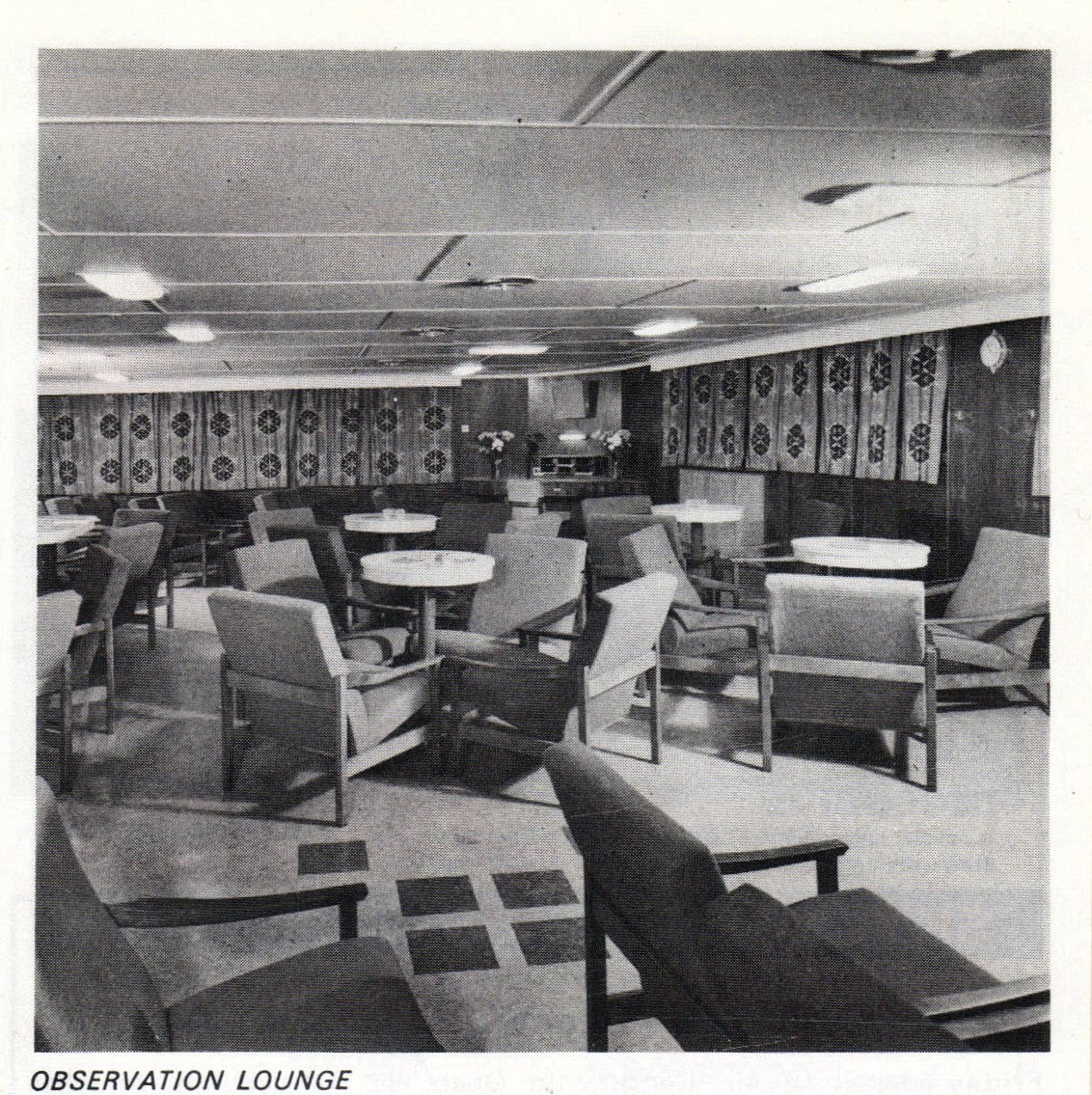
When built, the Columba and her two sisters, the Clansman and the Hebrides, had been equipped with passenger cabins and this enabled the Columba's summer schedule in the 70s and 80s to be marketed as "Mini Cruises". For example, on Tour A, three nights, you boarded at Oban on Monday evening in time for the sail down to Colonsay and spend the night on board there. Tuesday and Wednesday nights were spent alongside at Oban having spent the days on the Sacred Isle Cruise and the run out to Coll & Tiree respectively. The price in 1986 was £63 per person (£20 supplement for deluxe cabin with en suite shower and toilet) and breakfast, lunch and "high tea" in the self service cafeteria was included.

 The restaurant on the Columba (or one of her sisters) as seen in a 1967 MacBrayne brochure - the table service and white tablecloths had been replaced with self service and formica in the 70s

The two pictures below are from a MacBrayne's brochure of 1970:-


In winter in the 70s and 80s (when the Sacred Isle Cruise didn't run and Coll & Tiree and Colonsay were looked after by the Mull and Barra-'Boisdale ferries respectively) the Columba continued as the relief car ferry and was laid up at Greenock when not required where she is seen below in dry-dock in another superb picture by hebrides


That picture shows the vehicle loading hoist (down at car deck level) very clearly and also another less well known feature of the Columba and her sisters. Note the two vertical sliding doors, one up (left) and the other down (right). If you think they look a bit over-engineered just to seal the car deck while at sea, you'd be right. Commissioned at the height of the Cold War, these three car ferries were designed to be floating "citadels" (command posts) in the event of a "NBC (nuclear, biological or chemical) attack" and these doors were part of the equipment designed to hermetically seal the ship's accommodation. They were also equipped with apparatus to spray the decks to wash off nuclear fall-out etc.  
   
Cold War considerations aside, MacBraynes' priority in the 1960s and early 70s had been the introduction of car ferry services to the Western Isles even if, to begin with, this meant adopting less than ideal hoist-loading. In the 1980s the priority became to convert all the services to ro-ro.

In 1988, Calmac decided to axe the Sacred Isle Cruise and commission a new ro-ro ferry - the Lord of the Isles - which was also equipped with a hoist to cover the transition to serve Lochboisdale (ro-ro since 1974), Castlebay (converted to ro-ro 1989) and Coll & Tiree (converted to ro-ro early 90s). As the last remaining purely hoist-loading ferry in the fleet, the Columba was redundant and sold.

A vignette from an early 70s MacBrayne's brochure

But instead of going to the Aegean or the Red Sea pilgrim trade where most redundant British ferries go, the Columba was sold to a new venture started by a Yorkshire family who had previously operated canal boats: keen amarteur sailors in the Western Isles, they were storm-bound one day in Loch Scresort on the Isle of Rum, when they had the idea of offering exclusive "yacht-style" cruises on the west coast ...

... and as once again this post is getting overly long, this is a good point to break before the next instalment to come.

Thursday, July 29, 2010

Hebridean Princess

On 23 July 2010, the Queen and other members of the royal family left Stornoway in a blaze of publicity for a cruise round the Western Isles on a "boutique" luxury cruise ship she had chartered. The ship - which she had chartered previously in 2006 for a cruise to celebrate her 80th birthday - is the Hebridean Princess and it has an interesting history.

Picture credit Hugh Spicer

The Hebridean Princess was built in Aberdeen in 1964 as the car ferry Columba. She was one of three identical sister ships - the others being named Hebrides and Clansman - built for David MacBrayne Ltd to inaugurate the first car ferry services on the west coast of Scotland beyond the Firth of Clyde (where car ferries had been operating since the mid 1950s).

An artist's impression of one of the three new ferries from MacBrayne's 1964 summer brochure

The Hebrides was allocated to a new route from Uig on Skye to Tarbert (Harris) and Lochmaddy (North Uist) in the Outer Hebrides and the Columba to a new route from Oban to Craignure on Mull and Lochaline in Morvern. The Clansman was intended as back-up to the other two ferries but in summer was placed on the non-essential Mallaig to Armadale (Skye) run to keep her busy when not required to deputise for her two sisters on their "lifeline" services.

The three views below - courtesy of Ken Connell - show the Columba at Lochaline shortly after she entered service on 30th July 1964

The black gantry, left, is for loading silica sand from the nearby mine on to cargo ships, not for boarding the Columba! 

The Columba and her sisters technically belonged to the Secretary of State for Scotland and were chartered to MacBrayne's hence the port of registry at Leith rather than Glasgow as with all other ships in their fleet. In 1972, ownership passed to MacBrayne's and the port of registry was changed to Glasgow.

The Columba heads back towards Craignure and Oban
   
The original timetable and fares from MacBrayne's 1964 summer brochure

The initial summer schedule was four return sailings daily except Sunday to Craignure, two of which were extended to Lochaline. A motor coach came down from Tobermory via Salen to connect with the 10.45am sailing from Craignure to Oban and in the afternoon the coach met the Columba arriving at Craignure at 3.15pm to drive up to Tobermory. Thus did a combination of car ferry and motor coach replace the age old Sound of Mull mail steamer service which had sailed down from Tobermory every morning for Oban via calls at Salen, Lochaline and Craignure and returning in the afternoon.

The Columba and her sisters had capacity for 50 cars but they weren't ro-ro ferries of the sort familiar today where vehicles drive from the pier down a ramp adjustable to the height of the tide - called a "linkspan" - directly on to the ship's car deck. This is because ro-ro operations require investment in linkspans as well as ships and this wasn't considered justified on these "thin" routes on the west coast of Scotland in the early 1960s (c.f. the Channel and Irish Sea where ro-ro was well established in the 1950s).

Hence MacBraynes opted for the system adopted in the 50s by the Caledonian Steam Packet Company for their pioneering car ferries on the Clyde - "hoist-loading". With this system, which avoided the need for expensive linkspans, the ship was equippped with a vehicle lift which could be raised and lowered between the car deck and pier head. In the picture below of the Columba at Craignure, five cars have just been carefully positioned on the lift, the ramp is being raised and shortly it will descend to the car deck: a turntable in the floor of the lift will have helped the two cars nearest the camera be turned through 90 degrees and the car deck itself was liberally supplied with further turntables to assist the tricky manoeuvring required there to position the cars to be able to drive back onto the lift for disembarkation at the other end.


Being able to drive one's car on to the ship was a vast improvement on the previous generation of steamers  with their capacity for only a dozen or so cars which had to be individually craned aboard as seen below in another memorable shot from Ken Connell's collection, this time of the MV Lochmor (1930) at Lochaline in 1964 just weeks before she was replaced by the Columba -
    

But there was no escaping the fact that hoist loading was cumbersome and slow - particularly for caravans and commercial vehicles. MacBrayne's scheduled 30 minutes for a turnround at Craignure (cf 15 minutes today for a much larger ro-ro ferry) but this was hopelessly optimistic for a full load and the ferries regularly fell way behind schedule.


In 1969, however, MacBrayne's was fully nationalised (hitherto it had been 50% owned by British Railways and 50% by Coast Lines, a private shipping company later taken over by P&O) and placed under the state transport quango, the Scottish Transport Group. The STG's aim was to convert all of Scotland's west coast ferry services to ro-ro as soon as possible and as part of this process, in 1973, the Oban to Craignure run was upgraded to ro-ro and the Columba's sister ship, Clansman, was converted to a ro-ro ferry. Hence in 1973 and 1974 the Columba moved north to operate the Clansman's summer only Mallaig to Armadale run. In 1973, she also sailed three times a week from Mallaig overnight to Lochboisdale in South Uist, this sailing continuing twice a week to Castlebay in Barra. (These Outer Hebridean sailings were not repeated in 1974 because that year a new ro-ro car ferry service was inaugurated from Oban to Castlebay and Lochboisdale.) In winter, the Columba became relief ferry.

    Columba at Armadale, 1974 - Picture credit Phil Wilson

In 1973 also, the Columba and her sisters became the property of Caledonian MacBrayne, the company formed by the merger of MacBrayne's with the Clyde ferry operator, the Caledonian Steam Packet Company (which had also been taken over by the STG in 1969 having previously been 100% owned by British Railways).

In 1975, the Columba moved back to Oban to take up new summer duties but as this post is getting a bit over long, I'll come to this in the next episode.

Friday, July 16, 2010

Kyle of Lochalsh

Here's an interesting cutting from the Glasgow Herald of 2 June 1950 - a plan for the proposed development of Kyle of Lochalsh:-


The core of the development plan is the building of a new fishery pier with related infrastructure to the east of the Railway Pier on land which had been occupied by the Admiralty during the War and then in the late 1940s by the North of Scotland Hydro Electric Board in connection with the nearby Nostie Hydro Electric Scheme. 
  

As well as the pier, facilities mentioned in the accompanying article (see page 6) included two or three kippering kilns (to smoke herring into kippers), huts for the accommodation of fisher girls (to gut the fish landed), a quick freeze plant, a canning factory and an engine shop. Space for all this was going to be at a premium and there was talk of blasting away the hillside to create enough level space.

As ever with ambitious plans such as these, not all of it came to fruition. The fishery pier was duly built in the planned location and Kyle was - and remains - the site of a modest fish processing industry albeit prawns etc. nowadays rather than fish, I suspect. But I don't think any kippering kilns or canning factories were ever built. The early 1960s postcard view below of Kyle from the east seems to show the site a bit less developed than envisaged in 1950:-


The blue boat in that picture is MacBrayne's MV Lochbuie (1949-68) which served the route from Tobermory to Mingary (Ardmurchan). She was probably at Kyle for maintenance at the boat yard just out of sight to the right.

Note also that the 1950 plan includes a "Proposed New Road" running east along the coast of Loch Alsh towards Balmacara. This is what is now the main road out of Kyle heading east, the A87, but this part of the plan did not materialise for almost 20 years with this stretch of road not being built until the late 60s or early 70s. Before then, the A87 to Balmacara ran north (what's now the Plockton road) before turning inland and east to Balmacara at Erbusaig. (This road is also identified for straightening on the 1950 plan but this never happened.)


What was not anticipated in 1950 was the return of the Ministry of Defence in the shape of the establishment in the early 70s of the British Underwater Test and Evaluation Centre (BUTEC). Basically this involves testing submarines and torpedoes and whatnot in the Inner Sound immediately north west of Kyle. The shore base and pier for this was established to the east of the fishery pier, not on a level site blasted out the hillside as envisaged in 1950, but on land reclaimed from the sea over the tidal rocks in the foreground of the postcard view above.

Picture credit RCAHMS

The BUTEC buildings and pier are at bottom right of the picture above. It's now privatised and run by Qinetiq (I believe it's pronounced "kinetic") on behalf of the MoD.

Finally, another aspect of the 1950 plan which came to pass by land reclamation was the establishment of the playing field you can see at about 11 o' clock in the picture above over the tidal creek called the Pladaig. The 1950 article in the Herald reports that the villagers were undertaking this themselves without the benefit of any government assistance but £1,400 raised by a local entertainment committee.

I leave you with this photo of Kyle from the east. The fishery development site is broadly the buildings (mostly a small industrial estate now) in the foreground to the left of the main road (the A87 to Balmacara). At bottom left can be seen the road to the fishery pier and the BUTEC buildings are out of sight to the left.

Picture credit Daniel Blok

I wonder if they imagined a bridge to Skye in 1950?

If anyone can add to any of this or correct any mistakes, please do leave a comment.

Sunday, June 27, 2010

Eoligarry House

The original seat of the clan MacNeil of Barra, Kisimul Castle, is one of the most distinctive landmarks of the Western Isles and, fully restored, it is in the care of Historic Scotland and open to the public.


Of almost as much interest to me, however, is a later house of the MacNeil chiefs after Kisimul had been abondoned as a residence in the early 18th century. This was Eoligarry House at the north end of Barra. It was demolished in the mid 1970s but for many years formed an almost equally distinctive landmark at the opposite end of the island in stark contrast to the croft houses around it.


Picture credit RCAHMS

Eoligarry House was built around 1790 by Colonel Roderick MacNeil, the 40th chief, and as it stood in one of the most fertile parts of the island (indeed the site was doubtless deliberately chosen for that reason), it became the MacNeil chiefs' home farm as well as residence. As such, the house was surrounded by farm steadings and "offices" (which in 19th century Scotland signified buildings such as stables, workshops etc. attached to a big house) as well as a walled garden.
  
 
The MacNeils didn't enjoy Eoligarry for long, however, for the next chief, General MacNeil went bankrupt in 1838 (in common with a number of Highland chiefs around this time) and his estates were sold to meet his debts. Barra was sold to Colonel Gordon of Cluny from Aberdeenshire who had also owned neighbouring South Uist and Benbecula since the bankruptcy of the Macdonalds of Clanranald.

Cluny let Eoligarry Farm to a Dr MacGillivray in 1840 so Eoligarry House no doubt became a slightly grander than usual farmhouse. In the 1900s, Cluny's daughter, Lady Gordon-Cathcart, sold Eoligarry to Dr MacGillivray's two sons but in 1917 the farm was "raided" by landless men of Barra and parts of it staked out into crofts. To regularise this, Eoligarry Farm was bought by the Board of Agriculture for Scotland in 1919 and the rest of it divided into crofts as well. But the MacGillivray brothers retained the house until the survivor of them died in 1939.

In the 1940s, the now empty Eoligarry House was bought by the Roman Catholic church to serve as a church for the new community of crofters in the vicinity. It continued in this role until a new purpose built church was built in the walled garden in 1963. With no further role, the house fell into decay and was finally demolished in the mid 1970s. But the footprint of Eoligarry House and its walled garden and "offices" can still be seen on Google Earth - compare with the map above:-

   
As well as the church in the walled garden, some council houses have been built on the site as well. This is what it looks like today courtesy of Google Streetview:-

 
Was it an act of 70s cultural vandalism to demolish such a Georgian house? Probably, but you also have to ask what could be done with a decaying mansion in such an incongruous location. And as I type this, I answer my own question - convert it to a hotel. Better a restoration of Eoligarry House than the construction of the awful (in terms of architectural merit, I mean, not quality of service) Isle of Barra Hotel which was built - I think I'm right in saying as a flagship project of the old Highlands and Islands Development Board - at around the time Eoligarry House was demolished. Oh well, they just didn't think like that in the 60s and 70s, did they? No point moaning about the sins of the fathers. Doubtless someone will bemoan the demolition of the IoBH a hundred years from now - if it survives that long. Will Kisimul Castle survive them both?


Picture credit RCAHMS

Picture credit Ramsay Imlach

And again as I type this, I find the IoBH growing on me. Doubtless in the 1790s someone moaned about the incongruity of Eoligarry House's "modernistic" architecture!

PS - I believe it's pronounced EE-awl-uh-gurrie - but don't quote me on that.

EDIT October 2017 - see Eoligarry revisited for a further snippet of info about Eoligarry House.

Monday, June 14, 2010

Seaflower

When I was a child, in the early 70s, we used to go on family holidays to Gairloch in Wester Ross. Every evening, we would go down to the pier to watch the fishing boats unloading. In these days, there were about a dozen or so boats, mostly east coasters I think, which unloaded white fish (i.e. cod, haddock etc. as opposed to herring or prawns) at Gairloch. The pictures below were taken in the 80s after the new pier had been built but are similar to the scenes on a summer evening 10-15 years earlier I'm recalling:-


Back in the 70s, as kids we had a note-book in which were noted the names and numbers of the fishing boats just as trainspotters do with trains. Among the names I recall were the Scotia, True Love and Nimrod (INS 4) but the boat that sticks in my mind most clearly was the Seaflower.

About 35 feet long, painted a vivid emerald green and with just a simple wheelhouse at the stern, she bore registration number BRD411. This signified a port of registry at Broadford on Skye but the Seaflower's home port, engraved on her stern, was Ardheslaig (I believe it's pronounced "ARDISS-laig" but I'm quite prepared to be told that's wrong.) in Applecross on Loch Torridon. Whereas the other boats seemed to "bustle" at the pier, the Seaflower always seemed to be the last to arrive and approach with an unhurried air. I can also vividly recall the skipper, a big man called Calum in his 60s, with a rosy face, white hair, a blue boiler suit and a bunnet: he also had an unhurried sort of air about him.


I've no idea what became of the Seaflower (and alas have no pictures of her) but I was very interested to discover from the Ross-shire Journal the other day that there's now a new Seaflower on the go on Loch Torridon. It's operated by Calum's son Kenny and his daughter Gemma and offers trips out of Shieldaig. A bigger contrast from the Seaflower of my memories from the 70s it's hard to imagine:-


The picture above is grabbed from Torridon Sea Tours' lovely website which is well worth a look just for the superb photography of the Torridon area if nothing else. I wish the venture all success.

I wonder what Calum would have thought? I imagine he's the sort of gent who might have said something like "A catamaran for taking trippers out, you say? Ach well, we'll have to be seeing about that now, won't we just."

Wednesday, May 26, 2010

Craignure ferries (again)

A while back I wrote about what used to be understood by the words ferries and steamers and more recently highlighted this postcard of the ferry at Craignure on Mull:-


Disembarking from the "steamer" and going ashore by "ferry" looks like a lot of fun. Indeed, it was an experience still possible at the islands of Rum, Eigg and Muck until 2001 and I did it myself a couple of times at Rum in the early 90s off the "steamer" from Mallaig, the Lochmor (1979), in balmy summer weather:-


 But an article I spotted in the Glasgow Herald archives from November 1937 reminds us what a hazardous operation disembarking in to a ferry could be in winter:-


Here's the full story:-

During a storm on Wednesday afternoon two Mull ferryboats which meet the Oban and Tobermory steamer Lochinvar for passengers for Craignure, were driven ashore near Craignure. No lives were lost nor was anyone injured, but one of the boats was wrecked.

 One of them is motor-driven, and the other, a large open boat used for carrying heavy luggage and freight, had just cast off from the Lochinvar when, it appears the propeller of the motor boat was fouled and the steering wheel jammed.

 The anchors of both boats were thrown overboard to prevent drifting, while an endeavour was made to clear the propeller of the obstruction. On account of the high seas, which were lashing the small craft with heavy spray, the anchors began to drag, and the anchor ropes, becoming frayed by the incessant pitching of the boats, broke. Immediately the plight of the two boats was seen from the shore the alarm was raised, and villagers rushed to the beach to give what help they could.

 A telephone call was put through to Lochaline, the next port of call of the Lochinvar, asking her to turn back and give assistance if needed. Meantime the boats were driven to the shore, and it was not long before they grounded opposite Java Lodge. Some of those on the beach waded into the water to rescue those on board.

 A ram in one of the boats was drowned before it could be rescued.

 It must have been a severe storm indeed for the same edition of the Herald contains a rather hauting story of the Port Erin (Isle of Man) lifeboat attending an Irish schooner out of Arklow called the Invermore whose sails had been carried away and auxiliary engine had broken down. Rather than be taken off, the Invermore's crew preferred that the lifeboat return to port to send word to Liverpool to request a tug. The lifeboat complied but when it attempted to return to stand by the schooner, it couldn't find the Invermore. As the Herald laconically reported:

Since then there has been no word of the schooner, It is not known whether she obtained assistance from another vessel or whether she met with disaster.

I leave you with a picture below of the "ferry" (flit boat) from Muck alongside the "steamer" (ferry) from Mallaig (the Lochmor) in fairly benign weather in 1988.

Sunday, April 18, 2010

Sailing smacks

Until the 1880s, the Outer Hebrides (except Stornoway) and many of the remoter Inner Hebrides (e.g. Coll and Tiree) were dependent for communication with the mainland on sailing smacks.

These were beamy, deep draughted vessels designed for the carriage of cargoes rather than speed, around 60-80 feet long and with one or two masts. Some ran to a schedule, e.g. the mail smacks which ran from Poolewe to Stornoway until a steam service to Ullapool was introduced in the 1840s and from Dunvegan to Lochmaddy and Lochboisdale (N and S Uist) until the 1880s. But most just sailed as and when a cargo offered. Passenger accommodation was rudimentary in the extreme.

It's pointless trying to describe such a vessel without a picture but when I started to write this, I couldn't think of any picture of a West Highland sailing smack I'd ever seen except the one - called the Mary Stewart - only the vestigial remains of which are sunk in the sand at Scarinish on the island of Tiree.


Picture credit James and Tizzy 

But in the course of googling a picture of the remains of the Mary Stewart, I came across a fantastic series of pictures of smacks at Scarinish taken by Erskine Beveridge (1851-1920). He was a Dunfermline textile manufacturer and amateur antiquarian who took numerous photographs in the Highlands and Islands of Scotland. I believe the following photos date from about the 1870s:-


It seems that Tiree was quite a centre for sailing smacks trading around the islands but I don't know if any of these ships is the Mary Stewart. The building in the background is the Scarinish Hotel which is still very much on the go and getting some good reviews on Tripadvisor.

You can see more of Erskine Beveridge's pictures on the website of the Royal Commission on Ancient and Historical Monuments website. Just type "Erskine Beveridge" in as the search term and check the "online items only" box to get only returns with photos.

The sailing smacks were gradually replaced in the 1880s by the steamers of David MacBrayne, Martin Orme and John MacCallum for the carriage of passengers, livestock and cargo and the "puffer" for the carriage of bulk loads (typically coal). So I leave this post with a nice J Arthur Dixon postcard from the 1960s showing two puffers at Scarinish just yards from the remains of the Mary Stewart.