Thursday, March 10, 2011

Cruising from Ayr, Troon and Ardrossan

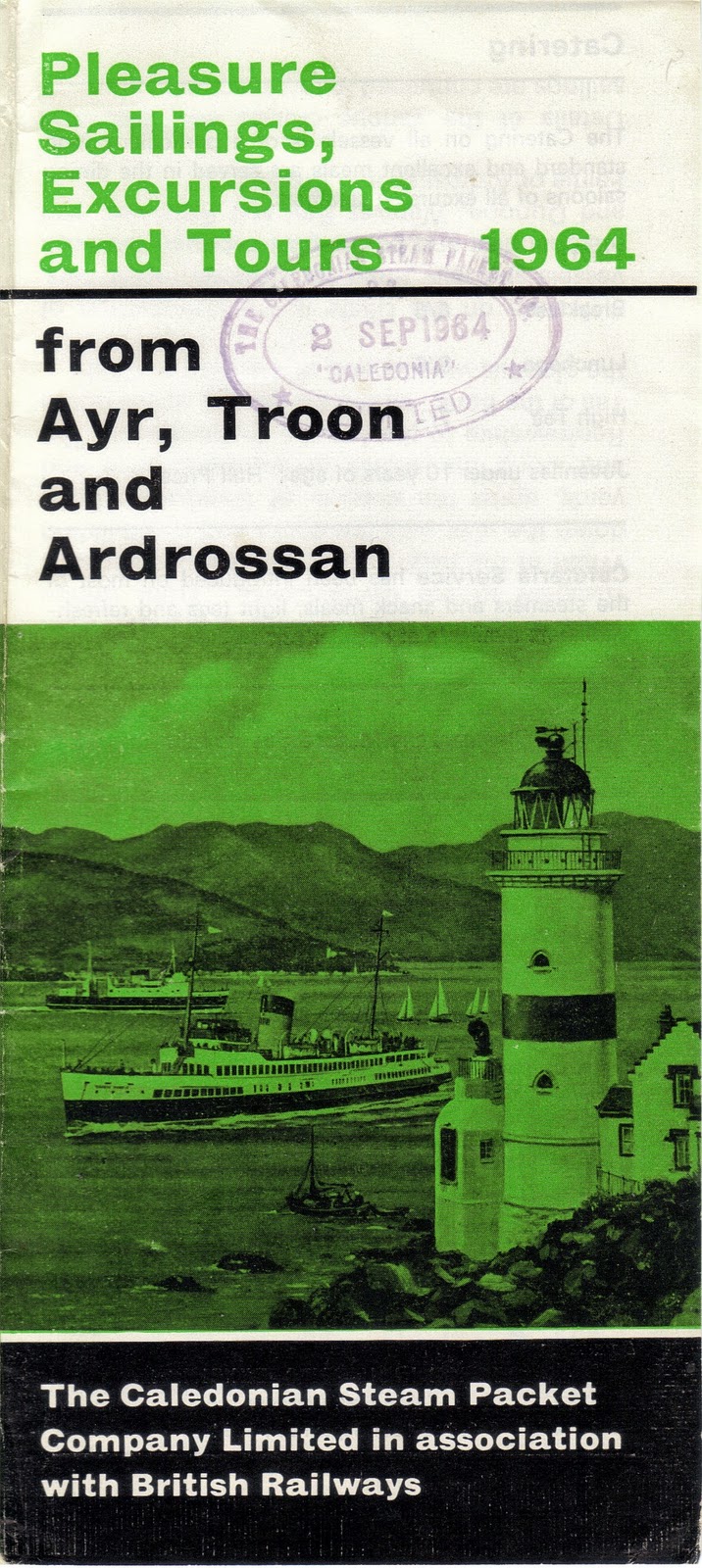
That's the cover of a fold out brochure I bought off eBay recently for 99p.

The fact that 1964 was the last year the splendidly named Caledonian Steam Packet Company (CSP) offered a programme of cruises from Ayr, Troon and Ardrossan is just the start of the history involved here.

For a start, the CSP was the shipping subsidiary operating on the Clyde of the nationalised British Railways. Due to a quirk of history, it managed to retain its identity and livery of yellow funnel embossed with red lion when the identities of the other pre-nationalisation railway shipping subsidiaries to Ireland and across the Channel were suppressed and BR imposed their standard red funnel with their "double arrow" logo. The CSP also became the "Caledonian" which gave its name to Caledonian MacBrayne (Calmac) when, divorced from railway control, it merged with David MacBrayne in 1973.

The ships pictured on the brochure next to the Cloch Lighthouse just south of Gourock on the east bank of the Clyde are, in the foreground, the SS Queen Mary II (1933). She ended up being the last dedicated cruising steamer in the CSP/Calmac fleet in 1977 and until very recently she was a floating restaurant on the Thames. The vessel in the background is one of the three "ABC" (because they were called Arran, Bute and Cowal) class of car ferries which operated to Dunoon and Rothesay from 1954. These were the first car ferries in Scotland (apart from the short crossings like Queensferry etc, now replaced by bridges).

The map on the back of the brochure - Ayr and Troon off the bottom!

The ship stationed at Ayr to give the cruise programme advertised in the brochure was the paddle steamer Caledonia built in 1934. During the summer of 1964, she sailed from Ayr every day at around 10.00am and called at Troon and Ardrossan before sailing to a variety of destinations around the Firth of Clyde including Largs, Rothesay, Loch Riddon, Millport, Dunoon, Loch Goil, Arran, Campbeltown, Tighnabraich and the Kyles of Bute.

The Caledonia was withdrawn from service in 1969 - she too later spent time on the Thames as a floating restaurant before being destroyed by fire in 1980. Calmac finally ceased all cruise sailings - since 1977 operated by diesel car ferries in their "spare time" - in 1996. (I think that was the year because I went on a sail on either the Jupiter, Juno or Saturn from Rothesay to Tarbert in 96 and I don't think there were cruise sailings in later years but correct me if I'm wrong.)

Finally, note that the brochure (top picture) has a date stamp 2 Sep 1964 saying "Caledonia". I think that means the brochure was picked up on the ship and stamped with the ship's own stamp kept on board in her ticket office. So that gives it a bit of extra "provenance" as they say on the Antiques Roadshow!

I leave you with two pictures of the Caledonia in her heyday in the 60s

Picture credit Mona's Isle
Picture credit Phil Wilson

Monday, February 28, 2011

The Pigeon House

I was reading the Glasgow Herald of 30 May 1806 the other day - "Why?", I hear you ask. The answer is because I can. You can read nearly every single edition of the Herald all the way back to 1806 for free via the Google News Archive function. I say "nearly every edition" because the late 1990s and early 2000s are Pay-per-View and even before then there seem to be a small random percentage of editions missing. But even so, it's an amazing archive to have access to for free. (Contrast the Scotsman which costs £159.95 for a year's access to their 1817-1950 archive.)


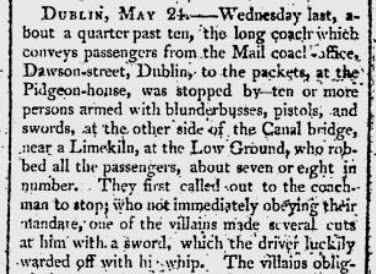
Anyway, in the edition of 30 May 1806, there was a report of the sort of crime you'd expect to see reported in 1806 - a mail coach being held up by highwaymen!


It happened just outside Dublin and the full story is as follows:-

Wednesday last, about a quarter past ten, the long coach which conveys passengers from the Mail coach office, Dawson Street, Dublin, to the packets at the Pidgeon-house, was stopped by ten or more persons armed with blunderbusses, pistols, and swords, at the other side of the Canal bridge, near a Limekiln, at the Low Ground, who robbed all the passengers, about seven or eight in number. 

They first called out to the coach-man to stop; who not immediately obeying their mandate, one of the villains made several cuts at him with a sword, which the driver luckily warded off with his whip. The villains obliged the passengers to come from the carriage, and rifled them as they came out, commanding them to turn their faces to a wall that was near, immediately after plundering them, that they should not have an opportunity of observing their persons. Lord Cahir, and Mr George Latouche were two of the passengers; from his Lordship they took about £400 and it is said 70 guineas from Mr. L. They robbed the other passengers of money, and also off some light packages from them; a small box which contained some of their articles, was found yesterday at the Commons of Kilmainham, to which place it is supposed they retired after the robbery, by going up the Circular-road, to divide the spoil. One of the persons in the Long Coach, we understand, they somewhat maltreated, because he did not readily submit to their depredations. The villains, we are informed, had rather a better appearance than might be expected of such offenders.

Hah! So blackguards and scoundrels they may have been but at least they were gentlemen highwaymen!

But as well as the report of a real life highway robbery, what piqued my interest was the coach's destination - "the packets, at the Pidgeon-house".

This means the coach was taking passengers from the centre of Dublin to the terminal for "the packets" - in effect the ferry service to Great Britain in the days before steamships. This was at a spot called the Pigeon House half way out along The Great South Wall which is the southern arm of the two great breakwaters enclosing the mouth of Dublin harbour on the River Liffey to protect it from the shifting sand banks of Dublin Bay.

It was called the Pigeon House because it was at this spot that, in the 1760s, John Pidgeon started selling refreshments to passengers waiting for the packets from a storehouse used in connection with the construction of the Great South Wall he was the caretaker of. In 1793, a hotel for packet travellers was built on the spot and this building still exists despite the site having been converted to a military fort and then a power station.

In the picture below, the former Pigeon House Hotel is the Georgian building on the left. The power station is now called Poolbeg but the road out to it from Dublin is still called Pigeon House Road.
   
But highwaymen on the way to the Pigeon House were probably less of a risk than "the packets" themselves as another story from the Glasgow Herald in 1806 graphically illustrates.


The edition of 26 September includes "interesting particulars" of the loss of the King George Packet from Parkgate (on the west coast of the Wirral on the estuary of the River Dee in Cheshire, a port long since silted up) to Dublin on a sandbank just an hour and a half into her journey.

The report suggests that running aground on the sandbank was an event which, if not exactly routine, was one about which "no apprehensions were then entertained" and it was just a case of waiting for the tide to refloat the ship. The problems seem to have stemmed from a change of wind direction which blew the ship onto its own anchor as it began to refloat and punctured its hull causing it to flood.

As the tide came in, she filled rapidly with water; the night was dark, with rain. Her passengers, mostly Irish harvest-men, about one hundred in number, who were going home with pittances of their labours to their families, were under hatches. The pumps were soon choaked, and the water came fast on the Irishmen in the hold, that they drew their large harvest pocket knives, and with a desperation that a dread of death alone inspires, slew one another to make their way upon deck.


The story goes on to report how the captain and "an Irish gentleman" abandoned ship in the ship's boat but thought better of it and went back on board. Others remained in the boat whereupon:-

One of the sailors in the boat, seeing a poor Irish sailor boy clinging to the side of the vessel, pulled him by the hair of the head into the boat, cut the rope that fastened it to the vessel, and the tide drove them away. At this time great numbers ran screaming up the mast; a woman with her child fastened to her back, was at the top mast head; the mast broke, the vessel being on her side, and they were all precipitated into the waves! Only five men and the poor Irish sailor boy have escaped; the remainder, one hundred and twenty five in number, among whom were seven cabin passngers, perished!

The "cabin passengers" were the gentry, exactly the sort of people who would have been on the coach to the Pigeon House held up by the highwaymen and it's all worth giving a thought to next time you board Stena Line's complimentary bus service from Dublin city centre to Dublin Port (on the north side of the Liffey almost directly opposite the Pigeon House) to get on a superferry to Holyhead.

Photo credit Peter Griffin


Sunday, February 20, 2011

The Great Glen Cattle Ranch

What connects trendy Edinburgh bar and restaurant Cruz with American style cattle ranching?


Well, the answer is not the steaks on the menu but the fact that, in a previous life, Cruz was the steam ship Ocean Mist which was the private yacht of Joseph W Hobbs, the Anglo-Canadian owner of the Great Glen Cattle Ranch between Fort William and Spean Bridge in Lochaber.

Below is a picture of the Ocean Mist berthed at Banavie on the Caledonian Canal near Fort William (Ben Nevis in the background) when it was Hobbs' yacht:-


Joe Hobbs was born in Hampshire in 1891 but emigrated with his parents to Canada in 1900. From ranching in Calgary, he became a naval flyer during the First World War and then went on to make a fortune in shipping and real estate. But he was ruined during the Great Depression of 1929 and that's when he came to Scotland and got involved in the whisky trade. Before long Hobbs owned seven distilleries, including the Ben Nevis Distillery at Fort William.

In 1945, Hobbs bought Inverlochy Estate at Fort William and renamed it "The Great Glen Cattle Ranch" with the idea of introducing American style cattle ranching to the Highlands of Scotland. Now I have to confess I don't understand enough about cattle farming to know the difference between "ranching" cattle and farming them in the usual Scottish fashion. Suffice it to say that the Greensburg (Pennsylvania) Daily Tribune reported in 1951 that Hobbs was employing "four Gaelic-speaking cattle hands. From dawn to dusk they range this Scottish ranch on horseback and carry 12 foot whips." And in the Glasgow Herald in 1957 Hobbs was quoted as saying that the ultimate object was to "make the hills of Lochaber like the English Downs or better."


Hobbs sold the Great Glen Cattle Ranch in 1961 but retained 300 acres centred on the estate mansion house, Inverlochy Castle. He died two years later, coy about whether he was a rich man but with his ideas about cattle ranching never really having caught on. But Joe Hobbs certainly left some legacies even if they were not the ones he imagined or hoped for.

His yacht, the Ocean Mist, you can read a detailed history of here. In short, she was built at Greenock in 1918 for the Admiralty as part of a programme to replace the many fishing trawlers called up for service as minesweepers and lost during the First World War. But with the end of the war, she was surplus and sold as a yacht to a member of the Guinness brewing family who adapted her fish holds to carry his racing cars to the Mediterranean. After passing through a number of hands, including doing duty during the Second War as a torpedo recovery vessel on the Clyde, she was bought by Joe Hobbs in 1960. After he died, the Ocean Mist was kept on by his son Joe, Junior and she remained on the Caledonian Canal until moved to Leith in the mid 1980s. I don't know exact sequence of events of her history there but this is what she looked like when first parked at Leith (pretty much how she looked at Banavie):-

Photo credit Martin Third


It was in 2005, I believe, after around 20 years at Leith, that the Ocean Mist was radically altered by having her original superstructure and funnel removed and replaced with the current superstructure as seen in the first picture in this post. The picture below shows her during the transformation:-

Photo credit Leith Podcaster
Meanwhile, back in Lochaber, Joe Hobbs, Junior and his wife opened their home as a hotel in 1969 and Inverlochy Castle Hotel has since gone on to become one of Scotland's finest hotels, with a Michelin star and patronised by the international glitterati. Joe Junior's wife, Grete, was still running the hotel personally in 1976 but I don't know if the Hobbs' still own it - I suspect not but I don't know who does. As ever, leave a comment if you know.

Photo credit Celtic Castles - Ben Nevis in the background
And the Great Glen Cattle Ranch is still on the go, 5,922 acres (according to Andy Wightman) based at Auchindaul Farm just up the road from Inverlochy Castle in the direction of Spean Bridge and belonging nowadays to Paulo Berardelli. I'm not sure if there are any gaelic speaking bull-whip wielding cowboys these days but they've kept up the white painted steading buildings with the GGCR logo in that distinctive typeface.

Photo credit Keith Long


I recall these buildings clearly from when we used to go on family holidays in the West Highlands in the early 70s (when I was about 7-10 year old). The GGCR shelters, clearly visible from the A82 between Fort William and Spean Bridge, were landmarks on our journeys by car and I always felt we were missing out on something by not stopping for a closer look. "We'll be stopping for chips at Fort William in about 10 minutes" was usually the riposte from my father.

I'm glad the GGCR buildings are still here. My father isn't.

Wednesday, February 2, 2011

Glenelg Inn

The Glenelg Inn has been through a few changes in its time.


The present establishment, as pictured above (from the east), is the third incarnation of the Glenelg Inn - or Glenelg Hotel as it used to be called - and is, in fact, just the stable block of the two previous incarnations. The first of these is pictured below (from the south west) in a postcard which bears a 1903 postmark:-


This is the building I've marked "Hotel" on the 1875 Ordnance Survey 6 inch scale map below. The present day Inn is the stable block behind it (to the north):-


At some point around the turn of the 19th/20th centuries, the hotel was extended to the west as seen in the following picture - the building in the postcard above is the lower wing to the right.


The Glenelg Hotel burnt down in 1947 with the only trace remaining being the floor tiles of the entrance porch which it's still possible to see in the car park of the present day inn - well, you could still see them when I was last there in the early 90s: I hope they've been preserved and if anyone can add a photograph or confirm or deny, please leave a comment.


The present day Glenelg Inn gets rave reviews on Tripadvisor but it was not always so. When Johnson and Boswell passed through Glenelg in 1773, Johnson had this to say about the inn they found there after a particularly trying day's journey crossing the Mam Ratagan on horseback:-

At last we came to our inn weary and peevish, and began to inquire for meat and beds. Of the provisions the negative catalogue was very copious. Here was no meat, no milk, no bread, no eggs, no wine. ... Whisky we might have, and I believe at last they caught a fowl and killed it.

But if the bar supper was a disappointment, the bedroom at the Glenelg was worse:-

We were now to examine our lodging. Out of one of the beds, on which we were to repose, started up at our entrance, a man black as a Cyclops from the forge. Other circumstances of no elegant recital concurred to disgust us. ... Sleep, however, was necessary. Our highlanders [servants] had at last found some hay, with which the inn could not supply them. I ... slept upon it in my riding coat. Mr Boswell being more delicate, laid himself sheets with hay over and under him, and lay in linen like a gentleman.


Boswell's account of the Glenelg Inn was scarcely less uncomplimentary:-

A maid shewed us up stairs into a room damp and dirty, with bare walls, a variety of bad smells, a coarse black greasy fir table, and forms of the same kind ... This inn was furnished with not a single article that we could either eat or drink.

The Glenelg Inn today

Sunday, January 30, 2011

Seconds from disaster?

Having been a yachtsman on the west coast of Scotland in the past, I'm a great admirer of the work of the RNLI. Hence I was a bit disappointed to see that their advertising agents appear to have been indulging in a bit of what I might call "tabloid" advertising techniques:-


Of course, the yacht is not sinking any more than the lifeboat is - it's just the swell obscuring parts of the respective craft. So unless there's a jagged reef of rock just yards out of view to the left of the yacht, it is manifestly not "seconds from disaster".

The blurb on the back of this flyer says:-

Twenty miles off the coast, in Force 9 gales, high waves and poor visibility, the sailing yacht Galasma's engine and electrics failed. Those on board could do nothing but hope for rescue. RNLI lifeboat crews battled the gale for a gruelling 10 hours, before bringing them safely home.

Let's analyse that.

Twenty miles off the coast, your engine and electrics fail. Well it's a yacht, could you not hoist your sails? Whatever, you're not "seconds from disaster" and it's not the case that you can do "nothing but hope for rescue". That's a criticism of the crew of the yacht of course, not the RNLI. But that photo doesn't look to me like a Force 9 gale - high waves and poor visibility, admittedly, but not Force 9. I really hesitate before accusing the RNLI of a direct lie, but the bit about "battling for 10 gruelling hours" to rendezvous with a sailing yacht, albeit with no engine or electrics but still floating upright and apparently with its mast and rigging all in place just doesn't ring true to me if that photo's anything to go by.

I'm going to give the RNLI - and its advertising agency - the benefit of the doubt and say they probably put the wrong story with the photo and the reality was something more like that the lifeboat was called out to take a casualty off a perfectly seaworthy craft.

Lifeboat at Castlebay, Barra - 2003
 

Sunday, January 23, 2011

Garvault Hotel - remotest in Britain?

The Garvault Hotel in Sutherland claims on its website to be the remotest hotel in Britain. It's rubbed shoulders with establishments in the Australian Outback and Alaska in a Forbes magazine remote places to stay survey but even if that seems hard to credit, it's pretty flipping remote.

Not content with being in the middle of nowhere, it's even half a mile down a side road off a road to the middle of nowhere.


And if you turn through 180 degrees from that view above, this is what you see:-


This is what it looks like close up:-

Photo credit - Colin Kinnear
And this is where it is:-

Before I acquired my first car in 1987 (an Alfa Romeo Alfasud reg. USX 9V), I used to pore over Ordnance Survey maps looking for impossibly remote and interesting places to go when I got a car and the Garvault Hotel was very much noted down for future reference. Although I did subsequently acquire a car, and a wife, and we did a lot of motoring round pretty remote country house hotels in the far wild reaches of the country, the Garvault always eluded me - perhaps because it was just too remote. Although when we acquired our first flat and had our first flat warming party, I recall being very intrigued to hear our new neighbour was a regular guest at the Garvault for the fishing: "Oh, at that very remote hotel in Sutherland - does it actually exist, then?" I asked. He was amazed I'd even heard of it.

   
I have to confess the Garvault Hotel has never crossed my radar since that evening in 1991 until today when I was doing one of my virtual tours round remote parts of Sutherland courtesy of Google Maps Streetview. I found myself virtually on the B971 approaching Garvault and I thought, surely the hotel won't exist any longer ...

But it does. There don't seem to be any TripAdvisor reviews but there's quite a funny article in the Telegraph you can see here - scroll about half way down. Here's a taster:-

I enter out of the blinding rain into a bar that for some reason immediately makes me think of the 1970s, in particular the 1970s of Party Seven cans, Double Diamond and New Faces on the TV. The Garvault is run by an English couple, but at first I meet only the husband, Graham. He is cheery in a manner that, were this a film, would presage some terrible event about to happen. 'We wanted to get out of the rat race,’ he explains, and their success seems beyond doubt.


That the Garvault Hotel is remote, we can all agree on, but is it the remotest in Britain? This is a challenge someone like me with too much time on his hands has to take up.

Now, of course, it depends on how you define "remote" but I'd like to offer as a definition the distance to the next permanently inhabited house. In that case the Garvault Hotel is 4 miles from the houses at Badanloch Lodge. And the nearest village is Kinbrace at 8 miles (admittedly just half a dozen houses but does have a railway station, a primary school and street lights).

I'd like to offer up as a challenger to remotest hotel in Britain, the Cluanie Inn on the A87 from Invergarry to Kyle Of Lochalsh at the head of Glen Shiel:-

Photo credit - Claypotts Productions
Assuming Cluanie Lodge 2 miles away is not permanently inhabited (unless there's a permanent housekeeper in which case I admit defeat), the nearest house to the Cluanie is Achnagart Farmhouse 8 miles west in the direction of Kyle down Glen Shiel. The nearest village is Shiel Bridge 10 miles in the same direction (no station or school but it does have a shop, petrol station and caravan park). Admittedly, there's two little cottages next to the Cluanie but I think they may be staff accommodation. But if they're permanently inhabited independent of the hotel, do leave a comment and I will admit my error.

Photo credit Allan MacIver
It also has to be admitted that the Cluanie Inn is beside a double track trunk road to Kyle of Lochalsh and the Isle of Skye whereas the Garvault Hotel is half a mile off a single track road from nowhere to the back of beyond. Judge for yourself.

I stayed at the Cluanie a number of times in the early 90s. The main reason for stopping there was because we could - in other words it served its function of being a wayside inn on a journey which could not be accomplished that day. It was because we were leaving after work from Edinburgh to go to Skye before the bridge and couldn't reach Kyle before the ferry went off for the night. It was very good, the Cluanie in these days, nearly 20 years ago - I hope it still is ...

Photo credit Callum MacLellan
I seem to have digressed away a bit from whether the Garvault Hotel is Britain's remotest. Do leave a comment defending it or offering other challengers (the Kingshouse on Rannoch Moor perhaps? The house at Altnafeadh's only a couple of miles away ...)

Garvault - Photo credit MolloF

Saturday, January 15, 2011

Connel Ferry

Local roadsigns ...


... and the Ordnance Survey ...

... both refer to it simply as "Connel" so it's pleasing to note that Scotrail and Railtrack still stubbornly refer to the last stop on the line to Oban as "Connel Ferry".


This is because, when the railway to Oban was built in 1880, there was a ferry here across the narrows of Loch Etive and not much else except an inn where the present day Oyster Inn now stands.

Extract from the ordnance Survey 25 inch scale map - note that it shows no detail of the north side of the loch because it was in a different parish from the south side.
On the beach opposite the Oyster Inn, the remains of the ferry slipway shown on the map above can still be seen:-


The narrowness of the mouth of Loch Etive and sunken rocks combine to produce a strong tidal stream, today called the Falls of Lora (but interesting to note marked on the 1870s OS map as "Falls of Connell") and when the tide is flowing at its fastest, the narrows look more like a turbulent river than an arm of the sea.

Picture credit - James T M Towill
The falls are just upstream (to the right when looking from the south side) of the ferry but must nevertheless have produced a boisterous crossing at times. One traveller recorded in 1797:-

"Leaving Dunstaffage, we crossed the narrow mouth of Loch Etive by what is called the Connel ferry. The tide rushes through this channel with such rapidity, that it sometimes forms a cascade of six feet. The ferry, in consequence, is frequently dangerous and always requires the cautious management of an experienced boatman The old pilot who conducted us over, with our horses had attended the ferry upwards of sixty years, and the management of it has been in the same family, handed from father to son for three hundred years. The mode by which we crossed it, reminded me of the rivers in Piedmont, the passage over which is exactly the same. The boat is launched from one side of the river, and intrusted to the torrent which carries it with great rapidity down the stream, the men all the while tugging at the oars, till at last it reaches the opposite side a considerable way lower down. By constant practice, the ferrymen are dexterous enough to reach generally the same point, where there is a sort of quay for landing; but this is not always the case, nor was it so when we crossed over. Sometimes the eddies are violent enough to turn the boat round, by which they lose the command of her, for a few seconds, and you are then hurried somewhat lower down the stream. Notwithstanding the perilous nature of the stream itself, the uncertainty of the old crazy boat they use, frequently thronged with passengers and terrified horses, who betray great uneasiness in passing I heard of no instance in which an accident had been fatal to any one." 

Connel from the west before the bridge
Having been transformed once in 1880 by the arrival of the railway to Oban, the scene at Connel Ferry was transformed again in 1903 by the construction of a bridge over the Falls of Lora to carry a branch line north to Ballachulish.

Connel Bridge from the east - picture credit Wikipedia

At first, the bridge was exclusively for use by trains and the ferry survived alongside it as can be seen on the 1906 OS one inch map:-


In 1909, a special carriage was adapted to carry a single car across the bridge and then, in 1914, a roadway was added so that vehicles could cross the bridge on payment of a toll. This, I think, would have marked the end of the ferry. Marie Weir's book Ferries in Scotland suggests the ferry continued until the railway line across the bridge was closed and the vehicle toll lifted in 1966 but I'm pretty certain she's mistaking the Connel Ferry with the Bonawe Ferry across Loch Etive at Taynuilt which - it is my understanding - continued as a car ferry until finally put out of business by the lifting of the vehicle tolls on the Connel Bridge five miles west. This is corroborated by the fact that the 1927 OS one inch map no longer indicates a ferry at Connel:-


So now the ferry is only recalled in the name of the railway station and the aptly named Ferryman's Bar of the Oyster Inn.


OS six inch map, 1871 - before the railway and bridge.