Sunday, July 3, 2011

Gourock-Dunoon ferry

Last week saw the closure of the first ever car ferry service on the west coast of Scotland - that between Gourock and Dunoon operated by Caledonian MacBrayne which opened on 4 January 1954.

MV Saturn approaches Dunoon for the final sailing - Photo credit Stuart MacKillop
First, I have to define "first car ferry service": I'm not including Stranraer to Larne in Northern Ireland which started in 1939 or the many short crossings (half a mile maximum) across lochs and estuaries such as the Erskine Ferry or the Corran Ferry which had been carrying vehicles since the 1920s or earlier. Gourock to Dunoon was the first "sea-going" car ferry within Scotland on the west coast. This is its story. 

As car ownership grew in the 1930s, the London Midland & Scottish Railway Company's shipping subsidiary, the Caledonian Steam Packet Company (CSP), began to draw up plans for car ferries on the prime Clyde routes. These were interrupted by the War but revived when peace returned and a car ferry service from Gourock to Dunoon eventually opened in 1954 with Scotland's first ever car ferry (by the same definition), the MV Arran. There followed two sister ships called Bute and Cowal and, between them, these three "ABC ferries" as they became known, covered the Dunoon service and another between Wemyss Bay and Rothesay which opened later in 1954. 

MV Arran on passage between Gourock & Dunoon in 1958. Photo credit Douglas Campbell
Vehicle traffic on the Dunoon route exceeded expectations but development was hampered somewhat by the method of loading vehicles onto the ships. This was the "hoist loading" system whereby cars had to drive, four or five at a time, onto a platform which was then lowered slowly by pulleys down to the ship's car deck. The same laborious process had to repeated for disembarkation at the other side. It was a huge advance on the previous system of driving over precariously balanced planks onto the deck of a passenger steamer when the tide happened to be at the right level but far from ideal.

Hoist loading cars aboard an ABC ferry in a line drawing scanned from a late 60s CSP brochure
In the late 60s, a private company, Western Ferries Ltd, recognised the limitations in the CSP's service and laid plans for an alternative car ferry service using the more sophisticated ro-ro system we're familar with today whereby vehicles drive down a ramp adjustable to the state of the tide (called a "linkspan") directly on to the ship's car deck. This service eventually began in 1973 between McInroy's Point just west of Gourock and Hunter's Quay just north of Dunoon.


The CSP (which changed its name to Caledonian MacBrayne in 1973 after merging with David MacBrayne Ltd that year) responded with plans to upgrade its Gourock-Dunoon service involving the installation of linkspans at both terminals and the ordering of two new ro-ro ferries, the Jupiter and the Juno which entered service in 1973.

But the CSP/Calmac had missed a trick somewhat in that its new service (which was replicated at Wemyss Bay to Rothesay in 1977 with a third new ship, the Saturn, which, with the 1973 sisters, were known as "the streakers") was not a totally "drive through" one like WF's (i.e. drive on via the ship's stern and off in the same direction via the bow or vice versa). Instead, vehicles would board over the stern of the ferry at Gourock (and Wemyss Bay) but disembark at Dunoon (and Rothesay) over a ramp in the ship's side landing on a linkspan let in at right angles to the pier face. Again, it was great advance on hoist loading but while the 90 degree turn on the car deck was not too much of a hardship for cars, it was no good for artics so, again, was not ideal.

This view aft down the car deck of the Jupiter (1973) by Dave Forbes demonstrates the 90 degree turn needed to disembark at Dunoon
So, despite the improvements to Calmac's Gourock-Dunoon service, it was no surprise that Western Ferries - with a shorter crossing as well as greater operational flexibility - secured a substantial proportion of the vehicular traffic to Cowal in the 1970s.

One of Calmac's "streaker" class ferries, MV Jupiter, on the firth while two WF ferries cross in the background. Photo credit Hugh Spicer
The next act in the story was political rather than operational. A state subsidised public sector competing with private industry may have been the norm under 1970s style socialism but it was anethema to Mrs Thatcher's government which took office in 1979.  The spotlight soon turned on the rival ferry services to Cowal. In its defence, Calmac pointed out that its was the service of choice for foot passengers in that its ferries departed from the doorstep of Gourock station with its links from Glasgow Central in contrast with WF's rather more "out of town" terminals. In fact, Calmac was carrying about two thirds of the foot passengers whereas WF was carrying about two thirds of the vehicles crossing the firth. There was also a strength of feeling in Cowal that, if Calmac's car ferry service were withdrawn, it would leave WF with a monopoly which might lead to increased fares. So a messy political fudge was arrived at in 1982 whereby Calmac would continue to operate car ferries to Dunoon but, in order not to compete too directly with WF, would be restricted to one crossing per hour and would only receive subsididy for the passenger element of the service. With one hand thus tied behind its back, it's hardly a surprise that Calmac's share of the vehicle traffic continued to dwindle ...

A single vehicle on the car deck of a ship designed to take 40 was not an uncommon sight. Photo credit Hugh Spicer
Matters continued like this until 2000 when the Scottish Government woke up to the fact it was obliged under EU law to put the subsidies it was paying Calmac out to competitive tender. Tendering services hitherto performed by "iconic" public sector bodies is always politically thorny and for a while it looked as if a European court case involving subsidised bus services in Germany (the "Altmark" case) might spare the SG the opprobrium but further investigation revealed that this was not so.

The requirement to tender applied to all of Calmac's routes, not just Dunoon. But what set Dunoon apart was that it was the only route in the network which had a private sector competitor. The solution arrived at in 2006 was that all the other routes were offered in one bundle (Calmac won this tender but that's another story) while Dunoon was offered separately on the basis that the successful bidder would have to operate a car and passenger service but with no subsidy. Not surprisingly, nobody bid for this dubious privilege, not even Calmac! The result was that the Scottish Government simply continued to subsidise Calmac to run car ferries to Dunoon as before (except that the service was now run by a company called Cowal Ferries Ltd. However this operated under Calmac branding and management and with their ships, the familiar "streakers", so this was not a change the travelling public noticed.)

Aboard the Jupiter - Picture credit Hugh Spicer
But if the SG thought it had finessed this irritating thorn in its side, it was wrong: Western Ferries cried foul and.the European Commission initiated formal proceedings for payment of illegal "state aid" (subsidy). It eventually ruled in 2009 that subsidising a passenger service from Gourock station to Dunoon town centre was unobjectionable in principle provided it was properly put out to tender. Hence a new tendering process began in which there would be a subsidy for a passenger service with an unrestricted timetable. The successful bidder could carry vehicles if it wanted to and at its own expense but this would not be compulsory as in 2006.

The result of the tender was announced on 25 May 2011 and the winner was Argyll Ferries Ltd. This is in fact another subsidiary of Calmac although to avoid even the perception of any of the mistakes of the failed 2006 tender, this will operate under its own brand. The underbidders were Western Ferries and Clyde Marine Services (the operator of the passenger ferry to Kilcreggan). Not surprisingly, none offered to carry cars.

         
Argyll Ferries will be offering a much more frequent service over a much longer day than Calmac (Cowal Ferries) did using two vessels. One is a ferry called Banrion Chonamara acquired from Ireland where she had been serving the Aran Islands. Seen in profile on the extract from AF's website above, she has been renamed Argyll Flyer for the new Dunoon service. The other is a vessel which Calmac had had on charter for a number of years to give peak time sailings to Dunoon to supplement the sailings by the "streaker" car ferries: she is called Ali Cat and has now been purchased outright by AF.

Ali Cat at Gourock - a bit of a rubber duck, lookswise IMO! - Photo credit Stuart MacKillop
And what of the 35 year old "streaker" car ferries? One of them was rendered redundant in 2007 upon completion of deployment on the Rothesay route of the third generation of Upper Clyde car ferries, the Argyle and Bute (II). So the Juno was laid up at Rosneath on the Gareloch to act as a source of spare parts for the two survivors, the Jupiter and Saturn. Their roles were now confined to Gourock to Dunoon and summer second ship on the Ardrossan-Brodick (Arran) run. When the Saturn ceased in the latter role at the end of the 2010 summer season, she took up the Dunoon run and the Jupiter was sent to Rosneath as well. As soon as it became clear that the future of the Dunoon run was likely to be passenger only, the Juno was sold for scrapping in situ at Rosneath. As I type this, there's little left of her. Within days of the formal announcement that Gourock-Dunoon was to go passenger only, the Jupiter was also sold for scrapping and was towed away to ship-breakers in Denmark on 25 June. Having been designed exclusively for the relatively sheltered waters of the Upper Clyde, there is no market for such old ships elsewhere (as there has been for other ex-Calmac ships of similar vintage, e.g. Iona (1970) and Pioneer (1974) in West Africa). This just left the Saturn to perform the final car ferry sailing from Dunoon to Gourock at 20.45 on Wednesday 29 June 2011. The Saturn then sailed to Ardrossan to take up a programme of extra summer sailings to Brodick. In the autumn, she will probably repair to "hot layup" at Rosneath and be retained in the medium term on standby to cover breakdowns on the Rothesay or Brodick routes.

MV Saturn sails away from Dunoon for the last time - Photo credit John Newth
Argyll Ferries did not get off to a brilliant start on Thursday 30 June, it has to be admitted: the Argyll Flyer is still not ready to enter service (she was still at Ardmaliesh Boatyard on Bute undergoing conversion) and her place had to be taken by a vessel called Clyde Clipper chartered from Clyde Marine Services at short notice. Time keeping on the first few days has been poor leading to trains for Glasgow departing Gourock before the connecting ferry had arrived - there's a suggestion the late running is due to the boarding gangways being too narrow for the passengers to be able to board quickly enough. It's a problem which has bedevilled many a previous Clyde steamer service! 

All grist to the mill of the nay-sayers - those who believe Western Ferries have been handed a monopoly. Well you didn't "vote with your wheels" and patronise Calmac so a classic case of you didn't use it so you lost it! No doubt the teething troubles of Argyll Ferries' new service will be ironed out shortly. It should be viewed as Calmac having gone back to its roots. The Caledonian Railway Company incorporated the CSP as a separate company in 1889 to circumvent legal diffulculties over, in effect, extending the rail network across the Firth of Clyde with ships. The same thing has been done in 2011 with the incorporation of Argyll Ferries.

MV Arran - first ever Scottish car ferry between Gorock and Dunoon

Friday, June 10, 2011

Taransay

Most famous as the location of the first ever TV reality show, the BBC's "Castaway 2000", the island of Taransay off the west coast of Harris in the Outer Hebrides is for sale at the astonishing price of £2 million.


The sale brochure by estate agents CKD Galbraith of Inverness (which you can download via this link) features beautiful photography of the island showing the Outer Hebrides at their stunning best in glorious weather but what are you actually getting for your £2m?

Well, it's basically a sheep-farm of 3,475 acres (1,400 hectares). That's pretty standard for a Scottish sheep farm but the Taransay sheep, all 680 of them, are not included in the price. You have to buy them and the all important right to collect the EU Common Agricultural Policy subsidies separately. That's also standard practice in Scottish farm sales but what's not standard about Taransay is having 2 miles of angry Atlantic Ocean to cross from Harris to get to your farm. There's no ferry (because nobody lives on Taransay) nor is there even a pier on the Harris shore opposite to embark from. 

Once you've managed, in reasonable weather (i.e. impossible October to March), to land on Taransay (no pier on the island either), what's there? Well there's a farmhouse in reasonable condition for a house in such an exposed location which hasn't been lived in permanently since the early 1970s:-


There's also the old school which has been converted to self catering holiday accommodation:-


Old schools are a common feature of deserted Hebridean islands. They date back to the late 19th/early 20th centuries when they still had sizeable populations. The population of Taransay was 76 in 1911. The houses of the native population (it's not always accurate to call them "crofters") were of the "black house" type with low drystone walls which, now roofless, have receded back into the landscape (although are still discoverable if you look carefully and clearly visible on Google Earth). But "public buildings" such as schools - churches are another example - were of stone and lime and slated and have survived more prominently in the environment. The island of Mingulay south of Barra is another example of a deserted island (abandoned in 1911) where the school and the church remain prominent while the houses have retreated into the environment.

It's often a similar story with the house of the commercial sheep farmer who intruded himself onto the scene in the second half of the 19th century - many's the Hebridean island with the gaunt remains of an empty farmhouse.  I don't know the history of the coexistence of the farmer with the native population on Taransay - it was probably tense and would be an interesting historical study.

Back in 2011, the farm buildings also remain on Taransay. The sale brochure describes them as "the Bothy" and providing "fairly basic" accommodation for groups of up to 10 people. For estate agents to describe something in such lukewarm terms must mean it's pretty crap and I'd guess it's not been maintained since the Castaways lived there in 1999. Certainly, the Bothy is not advertised as self catering holiday accommodation as the farmhouse and old school are on the island's website.


If they were situated on Harris (where there would be mains electricity and a public road to the front door so you can reach them 365 days a year!), the farmhouse would probably be worth about £150,000, the old schoolhouse about £100,000 and "the Bothy" about £50,000. So, given that the profits from a sheep farm on the mainland, never mind an offshore island are sweeties, what are you paying the other £1.7 million for on Taransay?

Well, a whole lot of this:-


and a big chunk of that:-

The thing is, you don't need to buy the right to enjoy "that". There's no such thing as a private island in Scottish Law a la Mustique or Necker Island in the Caribbean. Any yachtsman or kayaker is at liberty to land on Taransay and, provided he behaves "responsibly" and doesn't do it on the doorstep of the farmhouse or the other buildings while anyone's staying there, have a barbecue, camp for the night or walk all over the island. He wouldn't be allowed to fish the lochs or shoot the deer but I'm not sure that dubious privilege is worth paying seven figures for.

  In reality, the estate agents are hoping there's someone out there gullible enough to cough up nearly two big ones solely for the privilege of being able to say they're the owner of Taransay - it's really just an upmarket version of these rackets where you buy a square foot to call yourself the "laird" of Glen Teuchter.

Enter Ben Fogle, daytime TV presenter and most famous of the Castaways. He's been quoted in the Stornoway Gazette saying he wants to get a consortium together to buy Taransay for a wildlife reserve. Well, it's kind of already a wildlife reserve, Ben - it doesn't need you and your chums' money to make it one!

Tuesday, May 24, 2011

MV Loch Seaforth

As Caledonian MacBrayne take delivery this week of their latest ship, the MV Finlaggan destined to serve the island of Islay, and flesh is finally put on the bones of what has for long merely been an artist's impression, it's interesting to go back 64 years and look at an artist's impression of another new ship for service to the Western Isles:-


This was the MV Loch Seaforth ordered by MacBrayne's for the important run from Mallaig and Kyle of Lochalsh to Stornoway on the island of Lewis. The picture above is scanned from their 1947 summer timetable printed on very thin, post-war utility type paper of almost toilet paper thin-ness. Post war scarcity also led to the new ship not, in fact, being ready "early this summer" as the brochure predicted and being delayed until December 1947.

The artist's impression is a good likeness of how the ship ended up looking except that her funnel was actually a bit narrower and taller and she also ended up being called "Loch Seaforth" (two words) rather than "Lochseaforth" (one word). It wasn't a printing mistake in the brochure, though. In 1928, when the company passed from the MacBrayne family to the joint ownership of Coast Lines and the London, Midland & Scottish Railway Company, MacBrayne's adopted the convention of naming all their new ships after Scottish lochs but always as one word - thus "Lochearn" rather than "Loch Earn". The Loch Seaforth broke that rule and became the first new ship in the fleet with a two word loch name (although in 1934, an existing ship, the Plover, had been renamed Loch Aline). Thereafter, new ships named after lochs followed the same pattern unless a one word loch name was being re-used (thus "Lochdunvegan" (1950) because she was the second MacBrayne ship of that name but "Loch Carron" (1951) because there had never previously been a "Lochcarron" in the fleet).

The Loch Seaforth at Kyle of Lochalsh - picture credit clydeboy63
 The Loch Seaforth served the Mallaig-Kyle-Stornoway run for over 24 years until she was replaced by a car ferry, the MV Iona, in 1972. The following year, the mainland terminus for the Stornoway service was moved to Ullapool and also in 1973, while on passge between Lochboisdale in South Uist and Tiree, the Loch Seaforth struck a rock in the Gunna Sound between Coll and Tiree. The passengers were evacuated in the lifeboats (without injury) and the ship made it to Tiree but she sank alongside the pier (I remember watching this on Reporting Scotland - I was 9 at the time) and remained there until patched up and towed away some weeks later to be scrapped. As the shipping services on the west coast would be totally converted to ro-ro car ferry operations by 1975, the Loch Seaforth's days were more or less numbered in 1973 anyway but she bowed out early with the dubious distinction of being the last Calmac (or antecedent companies) ship whose passengers have had to take to the lifeboats! Let's hope a similar fate doesn't befall the Finlaggan entering service this week

Finlaggan at Port Askaig - picture credit Richard Cameron

Monday, May 16, 2011

Mallaig

Here's a postcard I bought off eBay recently:-


It cost £6.50 plus p+p which is way beyond my normal price range but what made this one a "must have" was the little vignette of fishing history encapsulated in the message on the back.

Postmarked at Mallaig on 27 February 1927 and addressed from the SS Adequate (a steam powered fishing boat), the message reads:-

"Dear Bro. We had a hundred cran & the price was ten bob. We are fishing at the Rhu Rea just now. The herring was down to five bob yesterday & some boats lost their nets and ropes too. I think we will be home next week if we get a shot to run with. Hope you are all well at Home. Alex."

A cran is a measure of herring equal to about 170 litres and containing about 1,200 ungutted fish. So at 10 bob - i.e. 10 shillings or 50p - a cran, a catch of 100 earned the boat £50. "Rhu Rea" is the headland of Rubha Reidh where there's a lighthouse north of Loch Gairloch. (I wonder why, if they were fishing off RR, they went south, a further distance and further from home, to Mallaig to discharge their catch rather than to Stornoway, closer and nearer to home?)

Rubha Reidh light - Skye on the horizon - Photo credit Andy Hemingway
If anyone knows the answer to that or is related to Alex or William Slater from Gordonsburgh, Buckie or knows anything about the steam fishing vessel "Adequate", then do leave a comment.

Gordonsburgh

Friday, May 13, 2011

The Parliamentary Churches

There are some awfully big parishes in the West Highlands of Scotland. In the early 19th century, one of the biggest was Kilmallie which included all the land on the west side of the Great Glen from north of Loch Arkaig to deep into Morvern as well as a big wedge of land on the east side of the Glen from Fort William to Loch Leven.


Another problem was parishes which were not only large but in which the church had ended up being in the wrong place due to shifts of population as a result of the Highland Clearances or the creation of new fishing villages (such as Tobermory and Ullapool) in the late 18th and early 19th centuries. A good example of the latter syndrome was the parish of Assynt in Sutherland.


The church was at Inchnadamph at the head of Loch Assynt which was a nice central location when the population lived in the inland glens but quite useless once it had been cleared out to the western and northern coastal strip and the new village of Lochinver. (Note, incidentally, that these two maps are not at the same scale. They make Kilmallie and Assynt look roughly the same sort of size but Kilmallie is actually much larger than Assynt.)

Ever since the Reformation (1560 in Scotland), there had existed a statutory procedure for building a new church where required, jurisdiction over such matters being vested in the sonorously titled "Commission for Plantation of Kirks". But the responsibility for actually paying for kirks, manses (Scottish equivalent of the vicarage) and the salaries of the ministers of the Church of Scotland rested with the "heritors" (landowners) of the parish. The initiative to "plant" (build) a new kirk had to come from the heritors and they were generally reluctant due to the multiplication of expense to themselves this involved.

A Highland heritor reluctant to put his hand is his sporran to pay for a new church.
The response to these tensions so far as the Highlands were concerned came with the General Assembly of the Church of Scotland appealing in 1819 for public funds for the endowment of new churches. 200 years ago, the provision of churches and ministers was regarded as a matter almost as (if not more) important than the provision of schools or dosctors would be today so Parliament eventually responded favourably with the Additional Places of Worship in the Highlands Act 1823.

This provided £50,000 of public money to build not more than 40 new churches (with relative manses), none to cost not more than £1,500. Provision was also made to renovate not more than 10 dilapidated churches and provide them with new manses. A stipend of £120 a year would be paid by the government to the ministers appointed to these "Parliamentary Churches", as they became known, and thus the heritors had nothing to fear bar the cost of maintaining the church to an amount not exceeding 1% of its building cost (i.e. max. £15 per year) so far as that wasn't covered by the pew rents of 2 shillings and sixpence per sitter a year. Imagine having to pay for the privilege of sitting in church! It was standard at the time and the 1823 Act provided that a third of the pews were to be set aside for the free use of poorer parishioners (and imagine the sort of "do you live in a coonsil hoose or a bought coonsil hoose" sort of snobbery that must have engendered!).    

The Act set up a Commission to oversee the building of the new churches and appointed as its consulting engineer (to use an anachronistic modern expression) the celebrated Scottish engineer, Thomas Telford: hence they are also sometimes referred to as "Telford Churches". They were all built in the late 1820s to a standard design (by William Thomson rather than Telford). For the manses, there was the option of the one or two storey design.


The example at Ullapool (now a museum) is typical with the Tudor "Y tracery" latticed windows and "spikily pinnacled birdcage bellcote" being characteristic of the Parliamentary Churches:-

Photo credit - The Poss
The manse at Hallin in Vaternish on Skye is a well preserved example of the two storey manse:-

Photo credit - RCAHMS
And the manse at Shieldaig, Loch Torridon is a good example of the one storey option - these are rather stylish Georgian villas:-


According to the Tenth Schedule of the Church of Scotland (Property and Endowments) Act 1925 (a more authoritative source it's hard to think of), 35 Parliamentary Churches (PCs) were built plus eight extra manses alongside churches which were renovated.

As well as those built in huge parishes like Kilmallie - which had two PCs built within its bounds, one at Corran of Ardgour and the other at North Ballachulish (Onich), these both to be served by the same minister whose single storey manse was at the latter location - and parishes in which the population had moved (Assynt where a PC was built at Stoer on the coast north of Lochinver), others were built on islands which weren't parishes in their own right (Iona, Ulva and Berneray). Others were built in the "new" fishing villages of the era (Tobermory, Ullapool, Plockton, Shieldaig, Portnahaven.)

The Parliamentary Church and Manse on Ulva - the "H-plan" is distinctive of the single storey manse design.
 Sixteen of the PCs are still in use, five have been rebuilt (Tomintoul, Tobermory, Lochgilphead, Shieldaig & North Ballachulish - all still in use), two have been demolished (Cross & Knock in Lewis), nine are intact but no longer in use as churches and four are in ruins (Berneray, Trumisgarry (N Uist), Oa (Islay) and Stoer). All of the manses are still standing but none - with the possible exception of Sandwick in Shetland which I'm not sure about - is still in use as a manse. The manse at Kinlochbervie is derelict.

The derelict Parliamentary Manse at Kinlochbervie - the little wings on either side are a classic part of the original design - Photo credit Gary Sutherland
 There's an irony about some of the Parliamentary Churches which is that, despite the great effort of having to get an Act of Parliament passed to get them built, many didn't retain the congregations they were designed for for very long. This was due to two factors. First, further clearances. This was exemplified by Ulva. In 1841, thirteen years after the PC was built, the island's population peaked at 859 but was reduced by clearance to 150 only 7 years later. By 1889, the population of Ulva had slumped to 53 and today is less than 20.

The second (and more prevalent) cause of the PCs losing their congregations so soon after they were built was "the Disruption" in 1843 whereby many Highland congregations walked out of the Church of Scotland to form the Free Church. Both syndromes (clearance and Disruption) are exemplified at what's probably the most famous of all the PCs, Croick in Easter Ross.

Croick Parliamentary Church - Photo credit Frank Stephen
The minister of Croick, the Rev. Gustavus Aird, led most of his congregation out to the Free Church leaving only two families worshipping in the Parliamentary Church. Two years later, in 1845, 90 people were evicted from nearby Glen Calvie and took temporary shelter in the church yard of Croick PC. The Glen Calvie clearance became famous for two reasons - first, it was covered "live" (as it were) by The Times newspaper and, second, a number of the evicted people scratched messages on the window panes of the church where they can still be seen to this day.

Scratchings on the window of Croick PC - Photo credit thefourthcraw
In combination with other less well publicised clearances from the glens around Croick Church, it is left at the end of the public road in a virtually deserted glen in a place less appropriate for a church it is now hard to imagine. Having said that, Croick remains in use to this day as a church despite - or perhaps because of - its history.

Inside Croick Parliamentary Church - photo credit Lee Carson

No doubt there are other Parliamentary Churches with good stories to tell. I'd particularly like to hear about how Kinlochbervie came to be the only one: (a) in use today other than by the Church of Scotland (it's a Free Presbyterian Church); and (b) where the manse is derelict.

I leave you with a map of all the PCs and manses - click to enlarge.


Sunday, May 1, 2011

The loss of the brigantine "Aid" of Dundee

Amongst the thousands of volumes digitised in Google Books are some volumes of early 19th century Scottish legal case reports. I was drawn to these as a retired lawyer but they're as of much, if not more, interest for the human interest stories from a bygone era and local history they contain.


One such is the case of Thomson v Bisset, a suit between the owners of the brigantine "Aid" of Dundee and the ship's insurers arising out of its loss in East Loch Tarbert, Harris, in the Outer Hebrides in 1819.

In October that year, the Aid sailed from Riga (now in Latvia but in Russia in 1819) for Londonderry with a cargo of flax seed. Nearing the end of her voyage on the morning of the 15th, the Aid was sailing down the Minch when she was "driven by stress of weather into the harbour of Scalpa in the Hebrides" - Scalpay, as it's called nowadays, an island off the east coast of Harris.


As the Aid closed the Outer Hebrides, she came within what's known in nautical parlance as "pilot's fairway". In other words, she was sailing close enough to land away from home to merit having on board a local pilot to navigate her safely. The nearest official pilot was at Stornoway, 24 miles away to the north, but the Aid took on board the assistant lighthouse keeper from the Eilean Glas lighthouse at the east end of Scalpay who conducted her through the Sound of Scalpay to an anchorage at the west end of island. She dropped anchor at 1.00pm. The assistant keeper returned to the lighthouse (one of the very few in the 1820s) about three miles away and the sun set that day at about nine minutes past five.

At 6.00am the following morning, about two hours after high water, the Aid set sail again for Londonderry. She planned to follow the wind (being a sailing ship, she had little choice) and leave Scalpay to the west via East Loch Tarbert. But shortly after weighing anchor, the Aid ran aground on a sunken rock. She was stuck fast and holed and, as the tide fell, the ship fell off the rock and sank and was a total loss.

The map below shows the Aid's route in from the north east via the Sound of Scalpay to her anchorage near point X. The dotted line shows her planned route out to the west on the morning of the 16th except she was wrecked probably round about point Y. The Eilean Glas lighthouse is at the eastmost point of the island.


The owners of the Aid duly claimed on their insurance but the underwriters - a Mr Bisset and two others who were each liable to the tune of £100 - refused the claim. Not because the master of the Aid had been at fault in allowing the ship to run aground - it is, after all, against such accidents that one is insured - but rather due to an arcane nicety of marine insurance law as follows: The owners of a ship give its insurers a warranty that it will at all times be adequately crwed. When the ship is "in pilot's fairway", this involves having a local pilot aboard to navigate it safely. It is recognised that an official pilot is not available everywhere and the underwriters were not suggesting it was incumbent on the master of the Aid to send for the nearest one at Stornoway before sailing from Scalpay. But it was incumbent on him to take such local assistance as might have been had, namely, the Eilean Glas lighthouse keeper or at the very least one of the local fisherman (some of whom, it was noted, could speak English as well as their native Gaelic.)

Looking from the west end of Scalpay over the water where the Aid anchored on the night of 15th October 1819. She arrived from the right and attempted to leave to the left.
Legally, it mattered not that, in fact, when conducting the Aid in to Scalpay the previous day, the lighthouse keeper had pointed out to the master the rock the ship foundered on and warned him to take care of it if leaving to the west. In other words, the Aid went aground on a rock the location of which was known and the presence on board of a pilot would not have prevented the grounding. But that was beside the point, legally - if the Aid was deemed to be insufficiently crewed by being within pilot's fairway and not having a local pilot on board, whether the lighthouse keeper or a local fisherman, then the owners were "in breach of warranty" and the insurance was void.


So did the absence of a pilot in the particular circumstances the Aid found herself in on the morning of 16th October 1819 mean that her insurance was void? Five judges of Scotland's highest court, the Court of Session, ruled. You can tell that they all felt it was rather a hard case but in the end they voted three to two that the Aid was insufficiently crewed by not having the lighthouse keeper or a local fisherman aboard when she weighed anchor from Scalpay. An object lesson in taking care to comply with the conditions of your insurance to the letter even when it makes no difference to the outcome!

The Aid is not the only vessel to have come to grief in the treacherous waters of East Loch Tarbert. The Royal Commission on Ancient & Historical Monuments of Scotland lists at least eight, not including the Aid or what I believe to be the most recent wreck which you could still see on a rock off the south coast of Scalpay from the car ferry to Tarbert from Uig in 2006 when I was last on that ferry. I don't know if there's anything still visible but you can see it on Bing Maps aerial photography:-

   
If anyone knows the story about that wreck, then do leave a comment.

Saturday, March 26, 2011

Troon to Campbeltown ferry

A new passenger ferry from Troon to Campbeltown begins on 1st April.

It's being operated by new-start Kintyre Express, a subsidiary of West Coast Motors, the locally owned Campbeltown bus company which already operates the Scottish Citylink coaches to Kintyre from Glasgow (whether as franchisee or sub-contractor I'm not sure).

The boat to be used is an 11 metre Redbay Stormforce RIB (rigid inflatable boat) with accommodation for just 12 passengers. Centrally heated but lifejackets to be worn at all times:-

 
The passage time is 1h 15m and combined with a 40 minute train ride from Glasgow to Troon, KE are claiming Glasgow to Campbeltown in less than 2 hours. That compares favourably with the 4h 25m on the coach except the "less than 2 hours" claim is a little disingenuous in that the train gets in to Troon 20 minutes before the ferry departs so it's really 2h 15m (and the train connecting with the Sunday morning sailing is an hour so that's 2h 35m)

How do the prices compare? Well it's £17 to Campbeltown from Glasgow on the bus but £50 on the Kintyre Express boat. Add £6.50 for the train and, as it's more than a mile from Troon Station to the harbour, lets call that £60 from GLA to CTN including the cab fare.

So the Kintyre Express is the equivalent of going on the Heathrow Express from Paddington (15-20 minutes - £16.50) as opposed to going to the airport on the Tube (about an hour - £5.00). But to my mind, these premium services only justify their fares if, as well as a much quicker journey time, they also have a "turn up and go" frequency. The Heathrow Express is every 15 minutes from about 05.00 to 23.30 seven days a week but the Kintyre Express only operates on Monday, Wednesday and Sunday with two departures on these days, one in the morning and one in the afternoon. Compare the WCM/Citylink coach with three departures, seven days a week.

But even if KE's restricted timetable does happen to suit you, a sailing "may" be cancelled if there are fewer than four passengers booked. I hate to be the harbinger of doom but I can't really see this taking off as a credible addition to the public transport network. I suspect it will degenerate into "bookable by parties of 3+ and, if you want to book, these are times we go at."


KE are also starting a Campbeltown to Ballycastle (Northern Ireland) service on 27 May with the same type of boat. This has a slightly more reasonable timetable of two departures a day, Friday to Monday. These are not subject to cancellation for lack of demand and the price is £30 single - compare that with £26 single on Stenaline between Belfast and Stranraer and this seems a bit more credible as an alternative tourist link between NI and Scotland. I wish it good fortune but it's only fair to say that previous fast passenger ferry services in Scotland have met with little success. 

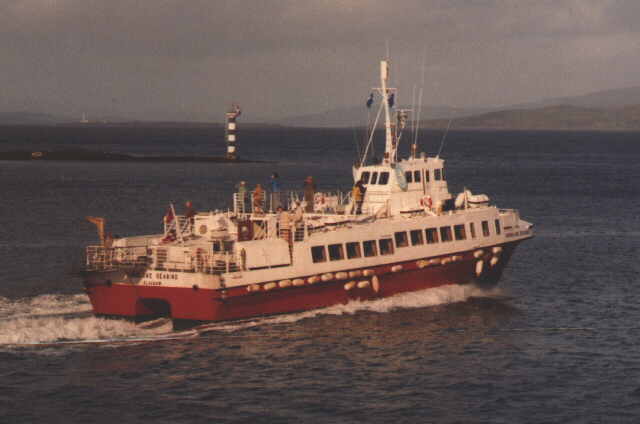
Western Ferries (the company that now operates the very successful McInroy's Point to Hunter's Quay car ferry across the Clyde) experimented with a catamaran called the Highland Seabird between Oban and Fort William and Moville in Donegal in the mid 70s but it only lasted two summers, 1977 and 78, as I recall. I went on it between Oban and FW once - great fun but I think my father and I were the only passengers aboard.


And more recently, a RIB service began between Tayvallich (on the mainland coast of Argyll) and the island of Jura in 2008 on a three year trial basis. This was with subsidy from Argyll & Bute Council but it's not yet been decided whether this will be continuing in 2011. See this link and this one for more info on the Jura ferry. It's my understanding KE are not receiving any subsidy for either of their services.

So, I say again, I wish KE all the best. If I had the opportunity, I'd make a point of using them but experience suggests that perhaps not enough people think like I do. But I hope I'm proved wrong. Let's see.

Photo credit Kintyre Express